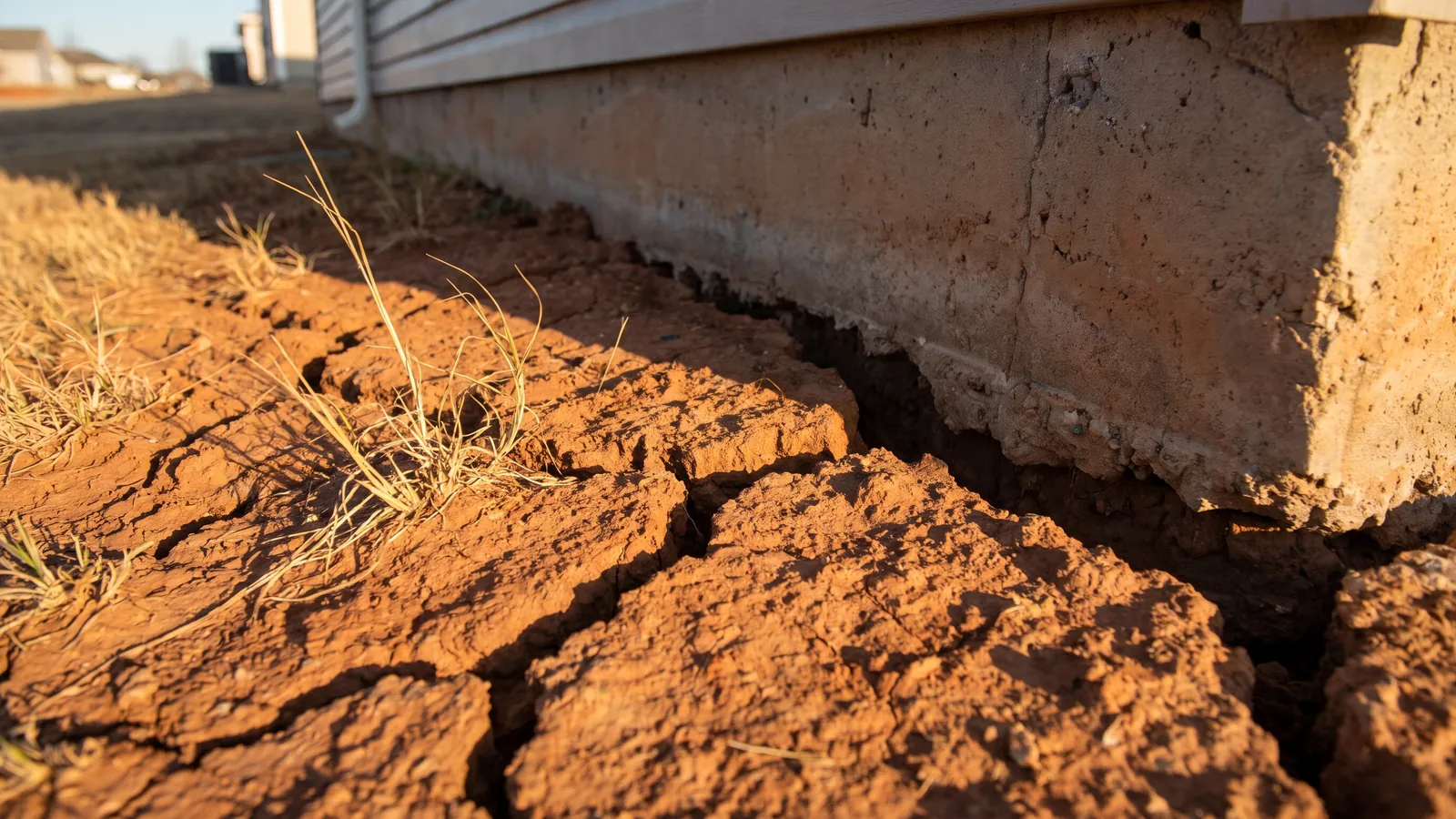
The clay itself
Much of the Pittsburgh region sits on heavy clay. Clay particles are tiny and flat, and they hold water between them. When they take on water they swell; when they dry out they shrink. A foundation sitting in that soil gets pushed when the clay swells and loses support when it shrinks. One season of it does little. Decades of it crack walls, tilt corners and open gaps around footings.
Clay also drains slowly. Rain that would soak quickly through sand stays in clay for days, pressed against the outside of a basement wall. That water pressure, called hydrostatic pressure, pushes water through cracks, through porous block and through the joint where the wall meets the floor.
The hills
Many Pittsburgh houses are built on slopes, sometimes very steep ones. On a hillside, the soil on the uphill side presses against the house far harder than the soil on the downhill side, and water moving downhill through the ground arrives at that same wall. That is why so many bowing walls here are on the uphill side, and why the downhill corner is often where settling shows up, especially where the lot was built up with fill.
The weather
The city averages around 38 inches of rain a year, spread through every month, and around 28 inches of snow. There is no real dry season to let the clay recover. January averages about 28°F, and from November through March the ground freezes and thaws over and over. Water in a crack freezes, expands, and opens the crack a little wider; then it thaws and more water gets in. The spring thaw in March and April releases the most water of all, which is when basement leaks and wall pressure peak.
What it does to a house
- Horizontal and stair-step cracks in block walls, with inward bowing.
- Diagonal cracks in poured walls, often from window corners.
- Seepage at the floor joint and white mineral crust on the walls.
- Sloping floors, sticking doors and cracked plaster above door frames.
- Porches, stoops and walks pulling away from the house.
What you can do
You cannot change the clay, but you can control how much water reaches it near the house. Keep gutters clean and carry downspouts at least several feet away, farther on a slope. Make sure soil and patios slope away from the walls. Avoid letting large trees grow right beside the foundation, and think twice before removing a big one close to the house without watching for movement afterwards. When movement or water has already started, bracing, piers and drainage deal with the damage and the cause together.
Questions people ask
Is all of Pittsburgh on clay?
Clay is common across the region, though soils vary from lot to lot and fill is common on hillside lots. The way water behaves around your house matters as much as the soil type.
Can clay soil be fixed?
Not practically. The approach is to control water near the house and to support or brace the foundation where the clay has already moved it.
Why are cracks worse after winter?
Freeze and thaw opens cracks a little more every cycle, and the spring thaw adds the most water pressure of the year.
Does a dry summer hurt foundations too?
It can. Clay that dries out shrinks away from the foundation, and corners can drop slightly. That is why some doors stick only in certain seasons.
Keep reading: Foundation warning signs · Bowing wall repair · Settling repair