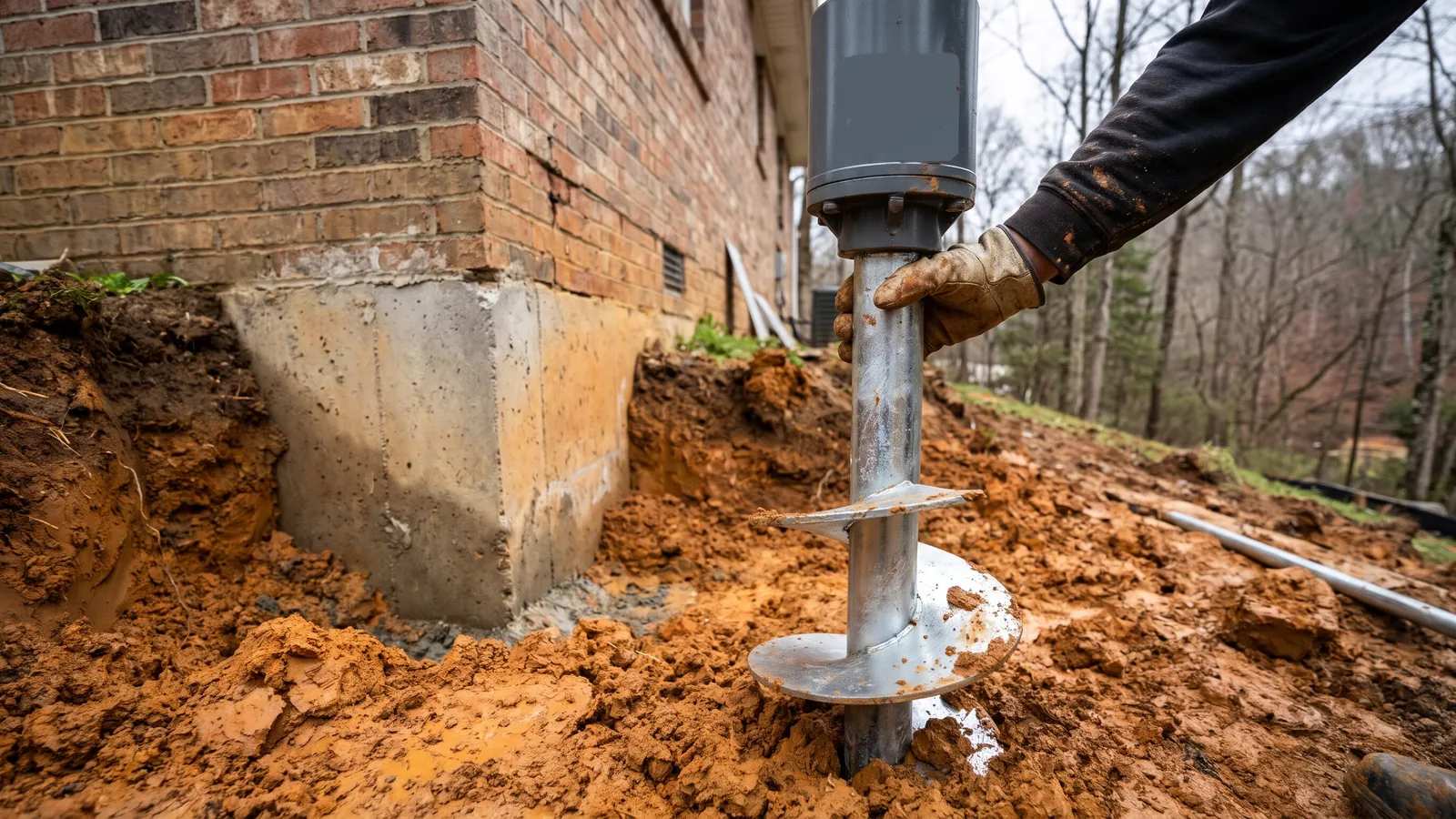
A pier is a steel shaft installed beside or under the footing and fastened to it with a bracket. Once it bears on firm soil or rock, the house is held up by the pier instead of the clay that let it down. In Pittsburgh, firm bearing can be a few feet down on one lot and much deeper on the next, especially on hillsides built up with fill. That is why we test as we go rather than assume a depth.
There are two kinds we install. Helical piers have screw-shaped plates welded to the shaft and are turned into the ground by a hydraulic drive head. The torque it takes to turn them tells us how much load they will carry, which makes them a good fit for lighter structures, porches, additions and places where the house is not heavy enough to push a pier down. Push piers are steel pipe sections driven down hydraulically using the weight of the house itself as the reaction, which suits heavier masonry houses common across the city and older suburbs.
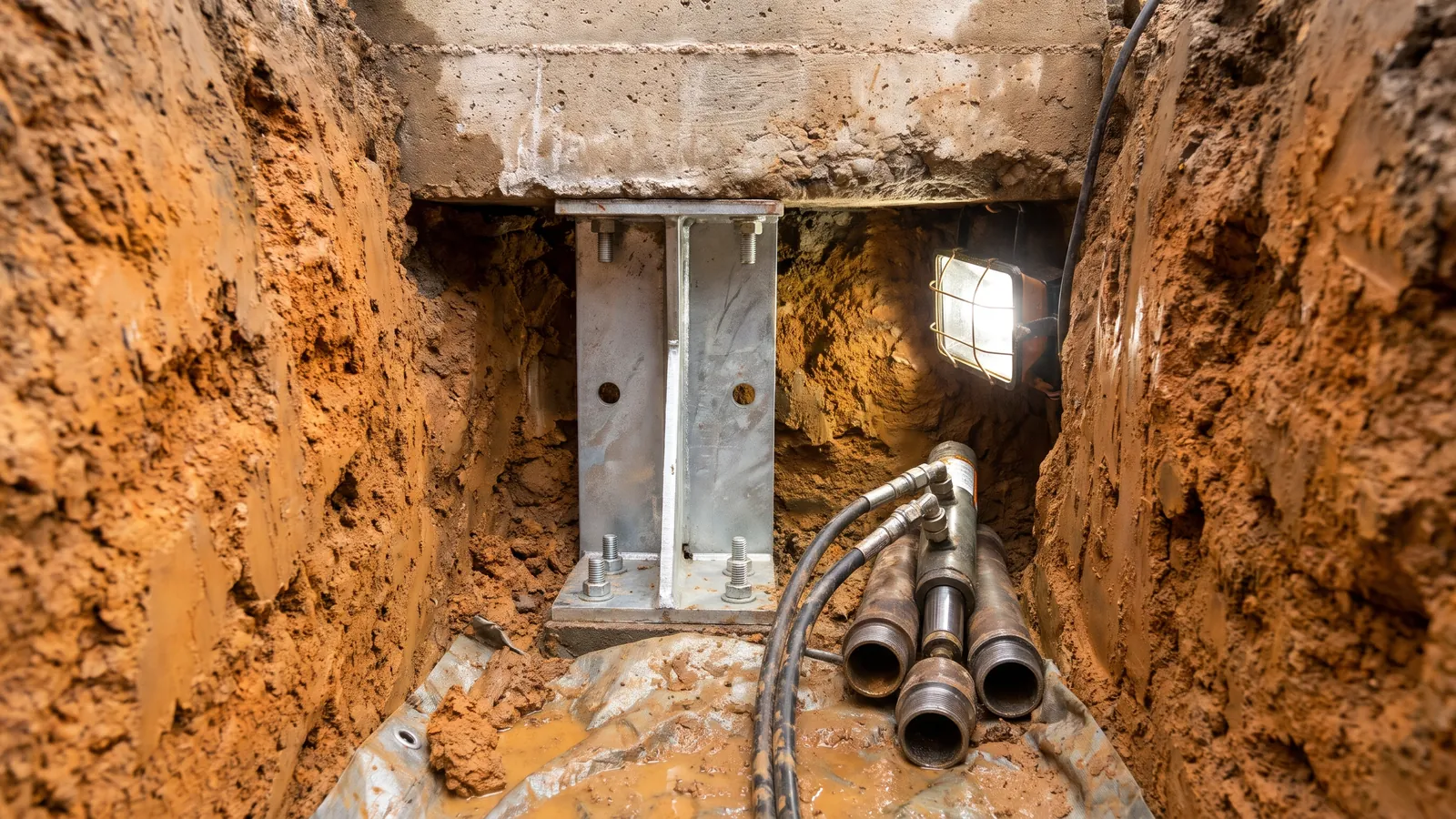
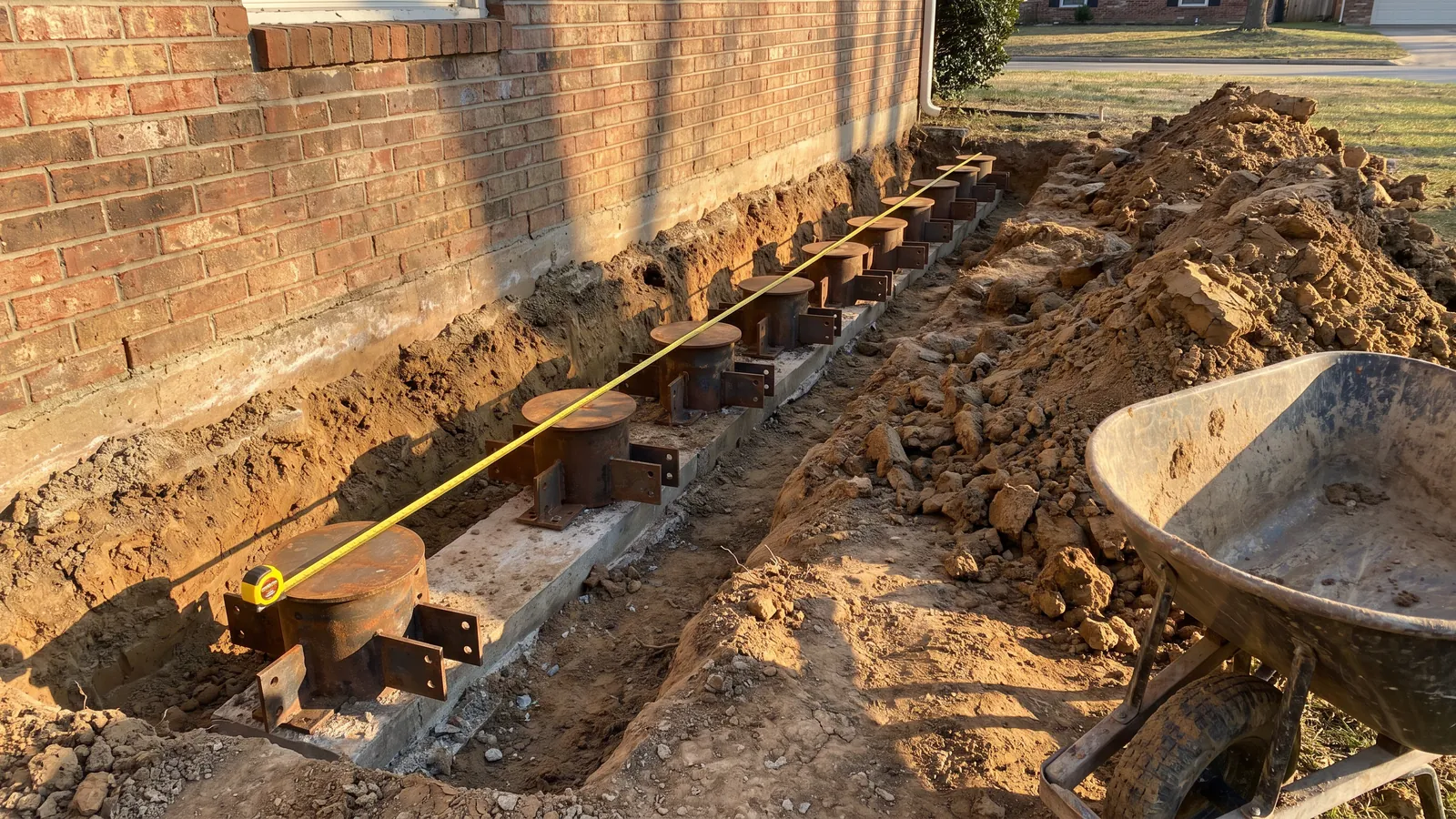
Either way, the work goes the same: a small excavation at each pier spot along the footing, the bracket fixed to the footing, the pier driven or turned down to its target, and then a careful, gradual lift if the plan calls for one. Then the holes are backfilled and compacted, and the soil around the house is regraded so water runs away instead of toward the repair. Inside, we check how cracks, doors and floors responded.
What the job includes
Depth proven, not guessed
Each pier is driven or turned until pressure or torque shows it is on firm bearing.
Right pier for the house
Helical for lighter loads and porches, push piers for heavy brick and stone.
Engineered spacing
Pier count and spacing set from the load and the soil, with an engineer involved when the job calls for it.
Controlled lift
Lifted in small steps while we watch brick, plaster and plumbing.
Permit handled
Pier work usually needs a building permit; we file it with the city or your township.
Yard put back
Holes backfilled and compacted, grade sloped away from the house.
Pier installation cost in Pittsburgh
| Job | Typical range | What moves it |
|---|---|---|
| Helical pier, installed (each) | $1,600 – $2,800 | Depth to firm bearing and access |
| Push pier, installed (each) | $1,500 – $3,200 | House weight and depth |
| Typical corner (3–4 piers) | $5,500 – $12,000 | Including excavation and lift |
| Porch or stoop support (2 helical piers) | $3,200 – $5,600 | Size of the porch |
| Engineer's stamped plan, when required | $500 – $1,200 | Set by the engineer |
Typical 2026 ranges for Pittsburgh-area houses, to help you plan. Your price comes after the free inspection, itemized and in writing, and the work starts only when you agree to it.
On the job
Questions about pier installation
How many piers will my house need?
It depends on how much of the foundation is settling and how heavy that wall is. A single settled corner often takes three or four. A whole wall can take eight or more. You get the count and the spacing on the written price.
Helical or push piers, which is better?
Neither is better in general. Helical piers work well for lighter loads and where we want a measured capacity from torque. Push piers suit heavy masonry walls. Many jobs use one type throughout.
Do piers need a permit in Pittsburgh?
Usually, yes, since they are structural. In the city that goes through Permits, Licenses, and Inspections. Boroughs and townships around the county have their own offices. We take care of it.
Will my yard be torn up?
Only at the pier spots, typically a few feet wide each. Plants and pavers in the way are lifted and set aside. We backfill and level the ground when we are done.
Can piers go in from inside the basement?
Sometimes, where outside access is blocked by a porch, a neighbor's wall or a steep drop. Interior piers take more work and cost more, and we tell you if that is the only route.
How long do piers last?
Galvanized steel piers are built to last as long as the house. The bigger risk to a pier repair is water, which is why grading and gutters are part of the job.